Mazes and Marching Bands[draft]
We have seen that a single cell, endowed with some sensorimotor capabilities and an evolvable controller, can respond effectively to an environment. The genotype played the role of an evolvable controller, and our phenotype was the behaviour of the cell in its environment. But how does this work with multiple cells?
The shift has important repercussions for our genotype-phenotype map. To see why, consider the following two challenges. Formulate a set of instructions to:
- guide someone through a maze.
- guide a marching band through a series of complex formations on a field (see Figure 1).
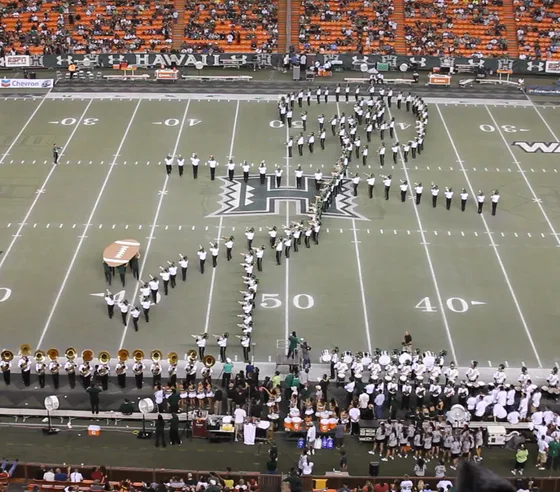
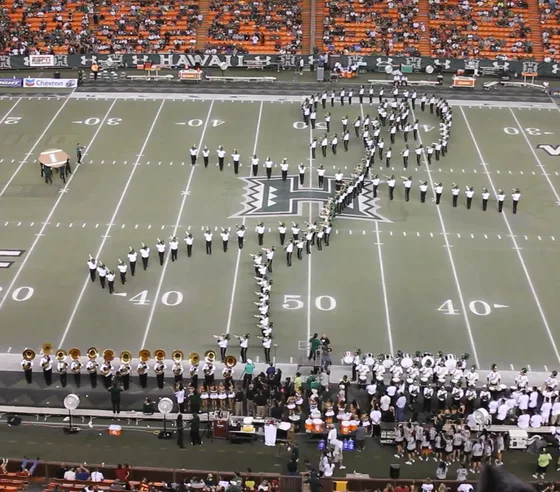
Both challenges require giving instructions that guide individuals. These instructions will include details about when to turn, how many steps to take and key landmarks to recognize and align with.
Typically, each member receives an individualized coordinate sheet, detailing their steps, positions, timing and some local contextual information to help coordinate their movements with others in the band.
Success in this challenge relies on the behaviour of a single individual. In this case, success is assessed at the level of the entire formation.
But to make it like multicellularity, we need to make the job even harder. First, you are allowed to give each marcher individualized instructions, nor are you allowed to tell them which role to play in the band.
These final constraints show that there is a radical change in the way the genotype maps to the phenotype after the transition to multicellularity. What stays the same is that the instructions are still for individual cells. Yet what these instructions achieve is something Our genotype has still remained the same, but our phenotype is no longer a property of cells, but of a collection of cells.
So it is not just a level of selection that has changed, but the relationship between genotype and phenotype now includes a set of processes that were never there.
Furthermore we move into the realm of self-organization. Much of the work on self-organisation takes part on XXXX.
An exception to this is Newman’s work captures. And also ?? Despite being thoroughly anti-genocentrist, there is something key to these ideas.
A modeling challenge
These cells acted alone, responding to their local surroundings. Now we want to look at a set of interacting cells. In this case, the local surroundings will effectively be the set of neighbouring cells. Each cell will be running the same AND program.
But in this section we shift to modeling multiple cells. The requires a shift in the level that we set goals and evaluate fitness. That is, fitness becomes a function of how a group of cells perform, rather than a single cell.
Importantly, however, these cells are identical. That is, they all have the same sensorimotor capabalities, and they all contain the same regulatory program. Crucially, however, they are all running the same program. TODO: Also, this is the only thing that we mutate.
We’ll approach this idea through a common framework: the cellular automaton.
Summary
But the evolution of multicellularity also entails a radical change in another component of Darwinian selection: the generation of variation.